
Dune: Awakening's Brilliant Silence - How an MMO Feels Authentically Dune
Dune: Awakening masterfully blends MMO and survival genres, delivering an authentic Dune experience through profound silence and atmospheric storytelling.
Alright folks, let's talk about something that's been blowing my mind since it dropped—Funcom's Dune: Awakening. We're in 2026 now, and honestly? This game has managed to do something I thought was impossible. It's taken the massive, chaotic formula of an MMO and the brutal systems of a survival game, and then wrapped it all in this... profound, almost sacred silence. And that's exactly why it feels like the most authentic Dune experience we've ever gotten in a video game. I mean, think about it—how many online games can you name where the most powerful storytelling tool isn't a quest giver or a cutscene, but the empty space between events?
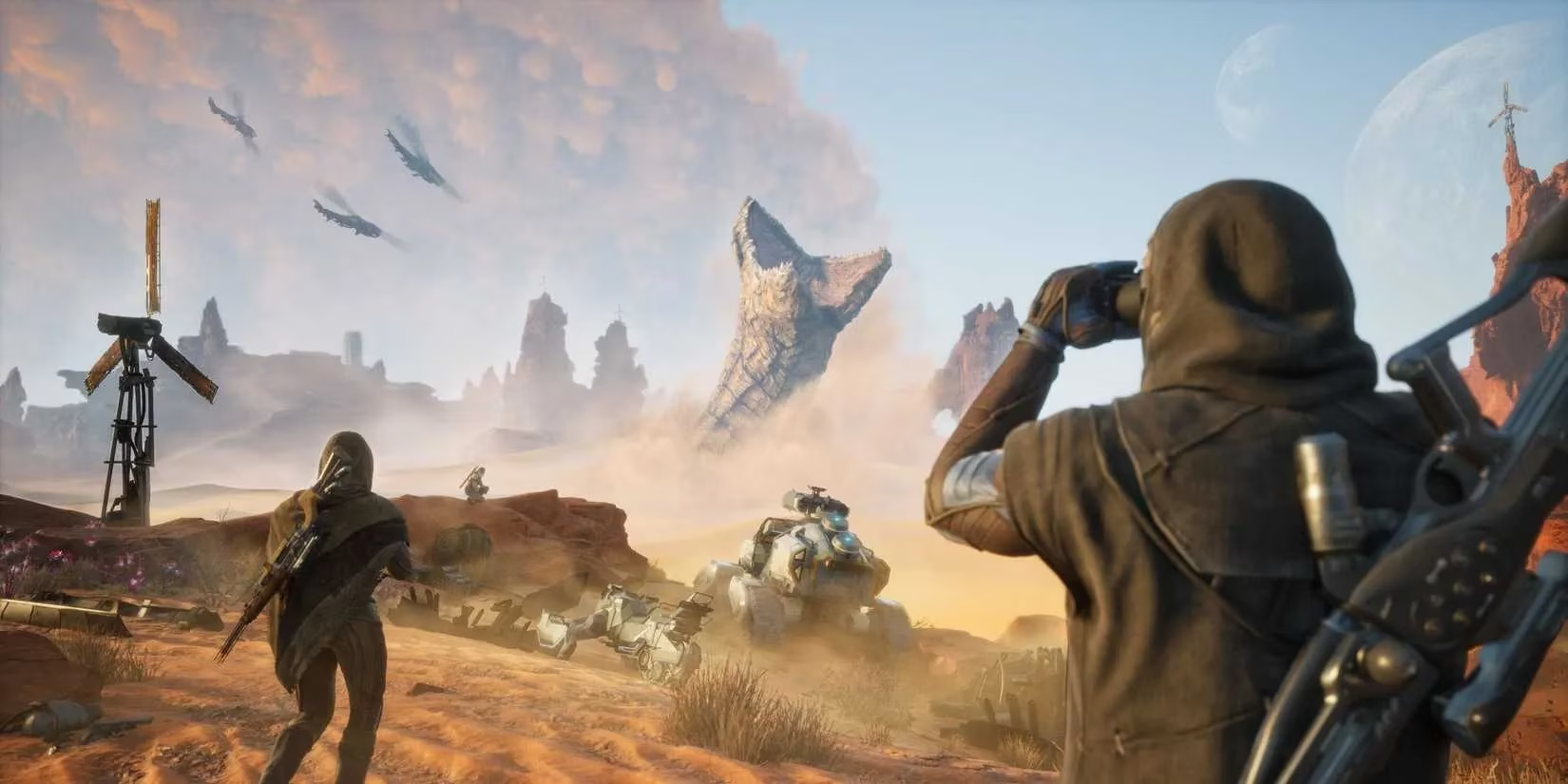
When you first boot up Dune: Awakening, you might come in with certain expectations. It's an MMO, right? So you're probably bracing for the usual chaos: crowded hubs, global chat exploding with memes and trade spam, a hundred players zerg-rushing the same objective. But that's not what you get. Instead, you're thrown into the vast, sun-scorched expanse of Arrakis, and the first thing you notice is the quiet. It's not empty—the world is alive with subtle sounds—but it feels profoundly alone. And that's the whole point. The game takes place in an alternate timeline where Paul Atreides was never born, but the soul of Frank Herbert's universe? That's present in every grain of sand.
So how does a massively multiplayer online game achieve this feeling of isolation? 🤔 It's a deliberate design choice that permeates every system. Let me break it down:
1. The Sparse Population:
Yes, there are NPCs. You'll find them in the few scattered tradeposts and hub areas. But these safe zones are tiny islands in a massive desert ocean. For 90% of your playtime, you are utterly alone. The NPCs are, as the original article perfectly put it, "butter scraped over too much bread." They give you just enough context and direction, then push you back out into the silence. This isn't a world built to comfort you; it's built to test you.
2. Dialogue as a Rare Commodity:
In most RPGs, you're drowning in dialogue. Exposition, lore dumps, companion banter—it's how the world builds connection. Dune: Awakening strips almost all of that away after the opening hours. The story isn't told through words; it's told through atmosphere. The narrative tools here are:
-
The relentless, baking heat of the twin suns.
-
The eerie quiet as you trek across endless dunes.
-
The faint, industrial hum of a distant spice harvester you can't even see.
-
And, of course, that deep, sub-audible rumble that makes your stomach drop... because you know what it means. Something massive is moving beneath your feet.
3. Player Interaction as a Luxury, Not a Given:
Even meeting another player feels like a significant event. It's not a common occurrence unless you specifically seek out a faction or a group. This scarcity makes every interaction weighty. Is that figure on the horizon a friend? A rival spice hunter? Or someone who will kill you for the water in your stillsuit? The silence between players creates a tension that constant chatter would completely destroy.

This is where the genius of Dune: Awakening truly shines. By embracing silence, it captures the core themes of Dune better than any dialogue-heavy adaptation could. Arrakis is a predator. The desert is the main character. The silence isn't just empty space—it's active. It's listening. It's waiting. You're not just managing hydration and crafting gear; you're engaging in a psychological battle with the environment itself. Every moment of quiet is pregnant with potential danger, making the world feel genuinely threatening and awe-inspiring.
The survival mechanics aren't just busywork; they're rituals of necessity that reinforce your fragility. When you're carefully distilling water from the air or scanning the horizon for the tell-tale signs of a Coriolis storm, the silence amplifies the importance of every action. There's no upbeat music or cheerful NPC to distract you. There's just you, your dwindling resources, and the immense, uncaring desert.
And let's talk about the sandworm for a second. 🪱 In any other game, a creature like Shai-Hulud would be preceded by fanfare, a boss health bar, and maybe a quest marker. Here? It's heralded by a tremor, a rumble, and a deepening of the existing silence as all other ambient sounds seem to fade away. The game trusts its atmosphere to build the dread. It doesn't need to yell; a whisper is far more terrifying.
So, what's the verdict after spending dozens of hours in this silent simulation? Dune: Awakening proves a radical point for the MMO genre: less is exponentially more. In a gaming landscape obsessed with constant engagement, loot explosions, and sensory overload, this game dares to be still. It understands that true immersion doesn't come from filling every second with noise, but from the mastery of quiet. The silence isn't a lack of content; it is the content. It's the space where your own apprehension, wonder, and strategy come to life.
It makes you appreciate the sheer scale and hostility of Arrakis in a way no movie or book ever could, because you are living it. You're not observing Paul's journey; you're forging your own, with the silent desert as your only consistent companion. In Dune: Awakening, the most valuable currency isn't spice or Solaris—it's a moment of safe, quiet respite. And that is a breathtaking achievement in game design.
The analysis is based on reporting from Polygon, and it helps contextualize why Dune: Awakening feels so strikingly “Dune” despite being an MMO: the game leans into negative space—long stretches of traversal, scarce social contact, and environmental dread—to make every human encounter and every mechanical choice (water discipline, noise management, storm timing) land with extra weight. That emphasis on atmosphere-over-exposition mirrors how strong game narratives can emerge from systems and pacing rather than constant dialogue, making the desert’s silence function as a form of storytelling pressure.