
Dune: Awakening’s Landsraad: Weekly Votes, Wild Decrees, and Desert Power
Dune: Awakening's Landsraad turns player guilds into a weekly political contest where decrees reshape servers.
Dune: Awakening did not just hand players a giant desert and a knife; it built a political machine underneath the sand. In 2026, after the game’s June 2025 launch, Funcom’s survival MMO still leans on the Landsraad as one of its loudest endgame systems. The idea comes straight from Dune’s fiction: a council of Great Houses, with House Atreides and House Harkonnen as the two heavyweight names everyone recognizes. The game’s version, however, turns that council into a weekly tug-of-war between player guilds, lesser Houses, and a handful of laws that can bend an entire server’s economy or PvP scene for seven days.
What exactly is the Landsraad in Dune: Awakening? It is a weekly political contest built around 25 lesser Houses. These lesser Houses act like mission-giving entities, and each week they choose to support either Atreides or Harkonnen. Whichever big faction wins a majority of those 25 votes takes control of the world—and all the servers that make up that world—for the following week. That is not a cosmetic title. Control means influence, and influence means decrees.
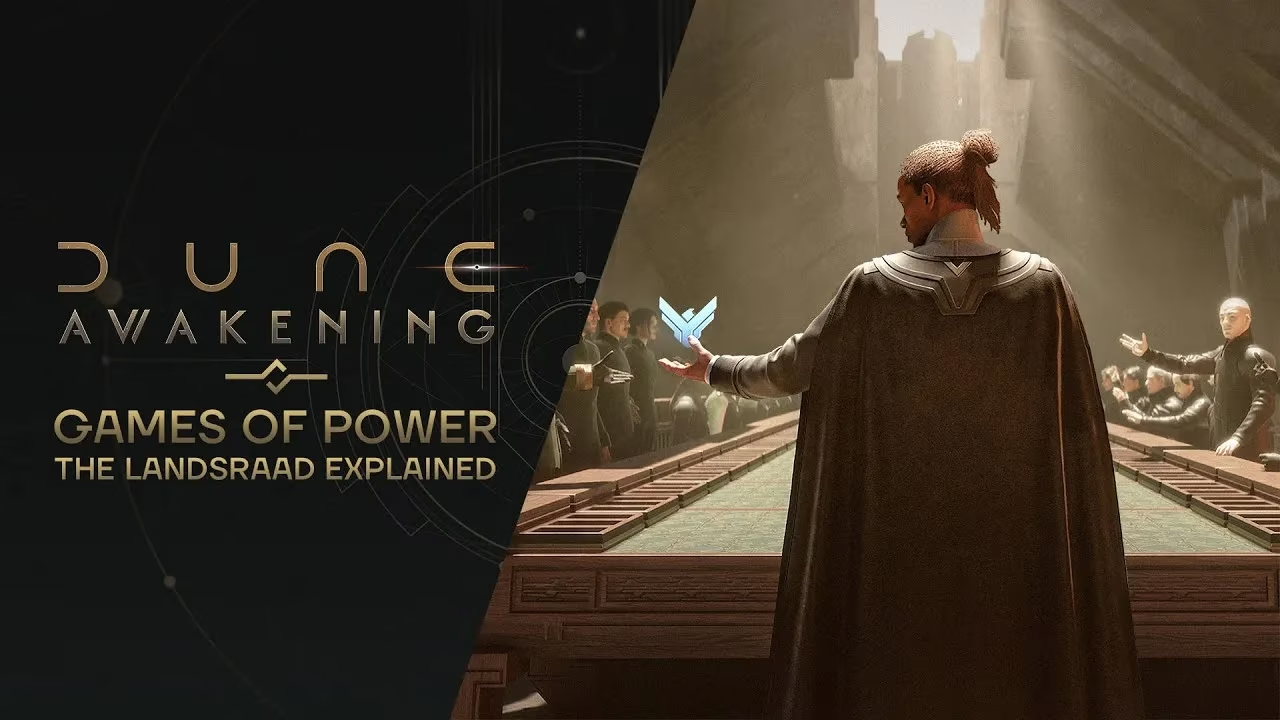
Player guilds do not sit back and wait for the vote to happen. They spend the week completing missions and objectives for the 25 lesser Houses, trying to sway those Houses toward their preferred faction. At the end of the week, the faction with the majority wins. Then the leaders of the player guilds that contributed to the winning side get to vote on a decree. A decree is a new law that stays active for one week. One law. One week. And some of those laws are absolutely monstrous.
It sounds simple until the decree list shows up. According to a beta player cited in the Dune: Awakening community, one decree cuts repair costs and refining times by 75% for the entire week for guilds supporting the winning faction. A 75% reduction in refining times is not a small quality-of-life tweak; for large-scale production crews, it is a turbocharger. Another decree lowers crafting costs by 25% for the week, which is another way to push the winning guilds far ahead in production. Then there are decrees that hand one faction exclusive tools, weapons, or armor through a vendor only that faction can access. Others increase ranged and melee weapon damage by 33%, or boost XP gain by 50%.
| Decree effect | Why it matters |
|---|---|
| 75% lower repair costs and refining times for the winning faction’s guilds | Production lines and vehicle fleets become much cheaper to maintain |
| 25% lower crafting costs for the week | The winning side can outproduce rivals and flood the market |
| Faction-exclusive tools, weapons, or armor from a vendor | Direct access advantage in both PvP and PvE |
| +33% ranged and melee weapon damage | Every fight tilts toward the winning faction |
| +50% XP gain | Faster progression for the winning side |
| The Right of Salvage | PvP deaths in the deep desert can loot all gear, not just some resources |
Only one decree can be enacted at a time, but that restriction barely softens the blow. Would players want to duel someone who is by default doing an extra 33% damage, or who has access to faction-exclusive armor and weapons? How does a guild’s production line keep up when the other side is refining materials 75% faster? Those are the kinds of questions that make the Landsraad feel less like background lore and more like a weekly arms race.
The most chilling decree is called The Right of Salvage. If it is enacted, dying to PvP in the deep desert means more than losing some collected resources. All of the player’s gear can be looted. That single law can turn the deep desert into a completely different place for a week—more paranoid, more predatory, and much more tense. Players who normally risk a backpack of materials might suddenly be risking everything they are wearing.
Funcom has clearly thought about the obvious balance problem: what stops one faction from winning week after week and stacking decrees forever? Joel Bylos, Dune: Awakening’s creative director, has said there are 'pretty good systems in place' to provide balance between the factions so one side is not constantly dominating a server. He has also mentioned plans for a third major faction—likely the Fremen—that 'will also have a role in that balance.' In 2026, that third-faction question remains one of the most interesting pieces of the Landsraad puzzle, because a three-way political map changes every calculation.
Winning votes is not only about PvP, either. The main method looks like claiming and holding control points in areas of the deep desert, battling other players for territory. Win the territory, win the vote. But players who prefer PvE can still help their guild and their faction. They can take jobs to invade NPC bases and kill the inhabitants. One mission shown by Funcom has House Torvold requesting that players wipe out a certain number of an NPC group called sandflies. Another House asks for a supply of groundcars, which means gathering resources, setting up a production line, crafting enough vehicles to fill the order, and delivering them. That is the Landsraad’s clever trick: it gives combat players a front line and industrial players a supply chain, and both can swing a vote.
For players looking at Dune: Awakening in 2026, the Landsraad is still the system that makes the endgame feel like Dune rather than a generic survival sandbox. It is political, it is petty, it is occasionally overpowered, and it can change the rules of an entire world for a week. The only real question is whether a guild will chase the vote for power, for production, or for the chance to enact The Right of Salvage and watch the deep desert turn into a hunting ground. 🏜️⚔️