
How Dune: Awakening's Short Delay Transformed Its Launch
Funcom's three-week delay of survival MMO Dune: Awakening until June 2025 turned a rocky beta into a polished launch, proving a wise decision.

The news rippled through Arrakis' devoted following back in early 2025 \u2014 Dune: Awakening would not hit its original target. The survival MMO from Funcom, set in the merciless deserts of Frank Herbert's universe, had been nudged to a June 10, 2025 release, with five-day early access kicking off on June 5 for Deluxe and Ultimate Edition buyers. Three extra weeks of development time might sound trivial, but for a title promising gameplay innovations previously unseen in the genre, that window became a crucible of refinement. Now, looking back from mid-2026, the delay stands as one of the smarter calls in recent MMO history.
Funcom's announcement on Steam made the reasoning transparent. Feedback from the ongoing Persistent Closed Beta had been relentless and invaluable. Testers flagged everything from sandworm encounter rhythms to spice-harvesting balance \u2014 the kind of granular detail that can make or break a survival experience. The studio concluded that acting on the most pressing feedback required that extra stretch. A major preview beta, held for journalists and content creators, poured even more data into the pipeline, with coverage exploding across April 25 streams and articles. That dual-beta approach gave Funcom a real-time understanding of both core loop issues and first-impression friction points.
The alternate-timeline twist of Dune: Awakening only raised the stakes. On this version of Arrakis, Duke Leto Atreides and Lady Jessica never had a son, reshaping the political and ecological landscape in ways that fans needed time to absorb. Players flooded the beta weekends to test survival systems under the twin suns \u2014 managing water discipline, navigating Coriolis storms, and vying for control of spice fields without a messianic figure to rally behind. The beta feedback loop tightened everything from base-building durability to the rhythm of faction conflicts.
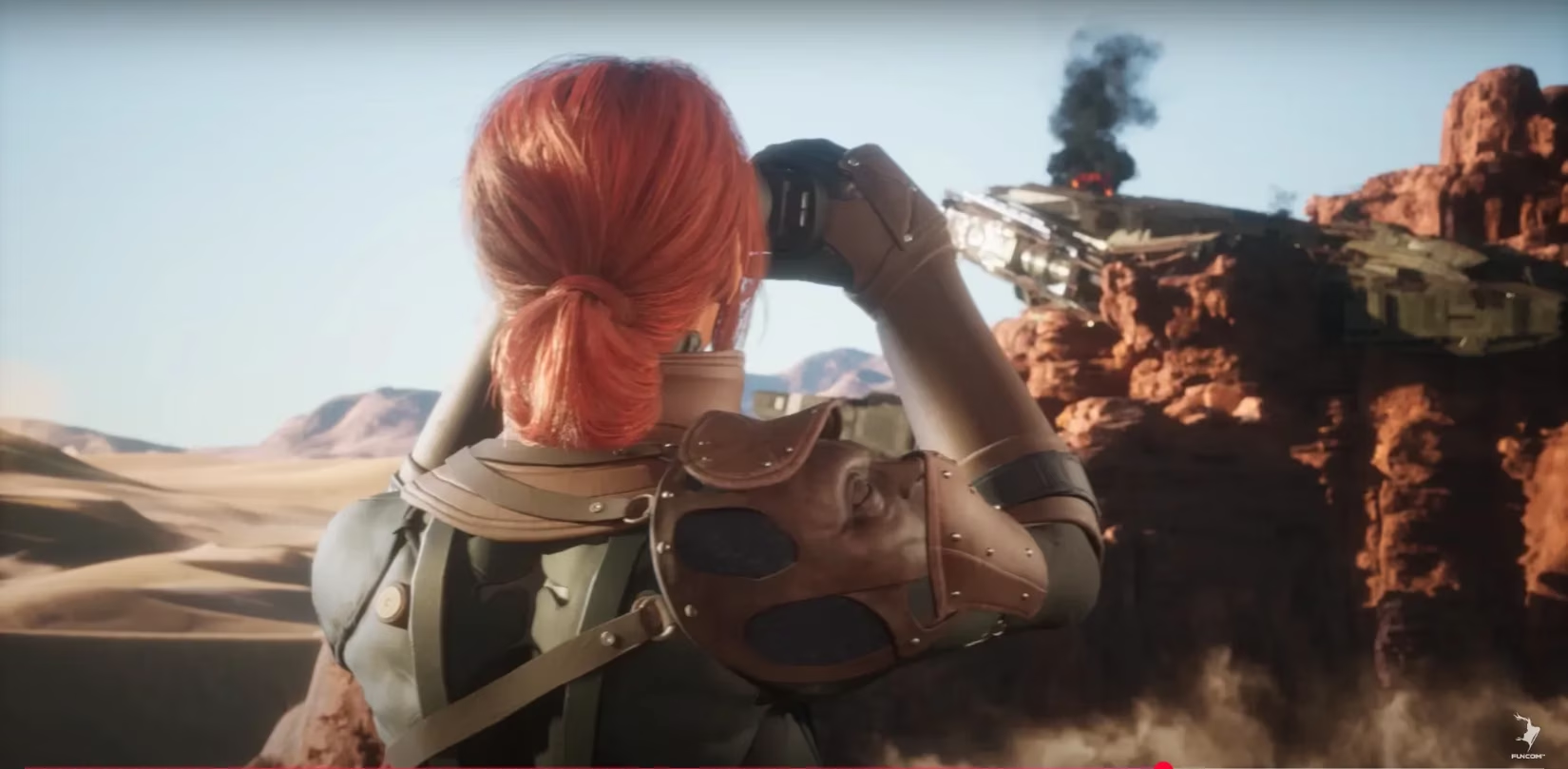
What followed the June launch proved that the three-week delay had been transformative. The early access period, initially seen as a reward for premium buyers, became a stress test for server infrastructure. Funcom had used the May beta weekend\u2014dubbed \u201clarge-scale\u201d by the developers\u2014to simulate launch day loads. Player counts soared, yet the dreaded queue times and rubberbanding that often plague MMO launches were largely absent. Community sentiment, once cautious, shifted toward enthusiasm as survival mechanics felt deliberately tuned rather than rushed.
Beyond technical polish, the delay bought cultural goodwill. Game developers have spent the 2020s pushing back against crunch culture, and a delay that prevents last-minute overtime resonates with a player base increasingly aware of labor conditions. Funcom\u2019s decision to extend the timeline by mere weeks, rather than months, demonstrated that even a tiny schedule adjustment can ease pressure on engineering and QA teams without angering an audience hungry to roam the sands. In 2026, it\u2019s a case study in humane project management.
The game\u2019s survival systems also benefited from deeper iteration. Base construction gained additional modularity, letting players build sietches that feel genuinely organic to the rocky outcrops. Spice harvesting \u2014 the heartbeat of Arrakis\u2019 economy \u2014 received a more nuanced risk-reward curve after beta testers showed how easily veteran groups could monopolize early zones. Sandworm AI, always a centerpiece, evolved to display more unpredictable movement patterns, making the desert feel truly alive and dangerous. Each of these changes landed because Funcom refused to ship a half-baked vision.
Guild and faction dynamics underwent quiet but critical refinement. The closed beta revealed how easily large alliances could lock down entire regions, stifling emergent gameplay for solo wanderers. In response, the developers tweaked territory control mechanics and introduced decay systems for neglected holdings, ensuring that the political map of Arrakis stays fluid even a year later. These adjustments sparked a living metagame where betrayals, trade pacts, and spice embargoes regularly make headlines in community forums.
Content pacing also reaped rewards from the delay. Early-game survival, the first few hours that hook a player, saw rebalanced thirst and heat management thresholds. New players reported a smoother learning curve during the post-launch period, a metric that directly impacts retention. Funcom later credited the extra weeks with allowing user experience designers to polish onboarding missions that introduce the stillsuit, the maker hooks, and the intricacies of sandwalking.
From a 2026 perspective, Dune: Awakening has cemented itself as a benchmark for survival MMOs. The sales figures tell part of the story, but player sentiment surveys consistently point to the \u201cJune 10 polish\u201d as the turning point. The game\u2019s current roadmap includes expansions that explore the deep desert and the polar regions \u2014 content that feels earned precisely because the foundation was laid carefully. The three-week wait in spring 2025, once a source of mild frustration, is now remembered as the moment Funcom chose quality over calendar deadlines.
Ultimately, the delay served as more than a scheduling footnote. It validated a development philosophy that prioritizes player feedback without succumbing to feature creep. For prospective players wondering if a short postponement spells trouble, Dune: Awakening stands as proof that when a team listens, even a handful of extra days can reshape a desert into a home. The spice flows, the sandworms hunt, and thanks to that May beta and its aftermath, Arrakis feels exactly as hostile \u2014 and beautiful \u2014 as it should.