
My First Night Back in Dune: Awakening After the Deep Desert PvE Shift
Dune: Awakening's 1.1.0.17 update transforms the Deep Desert, turning southern zones into PvE havens while keeping northern PvP risk-reward hotspots.
I logged into Dune: Awakening last night with the same tightness in my chest I used to feel before crossing into the Deep Desert. For months, that endgame region had been a furnace where PvE-focused players were fuel, not participants. But the latest hotfix—1.1.0.17—arrived faster than a sandstorm rolling over the Shield Wall, and I wanted to see if the southern half really had become a place where I could breathe.
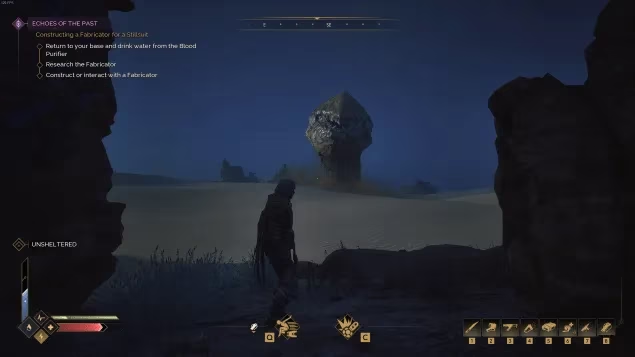
The Deep Desert now folds open like a living map, its lower half exhaling the constant fear of ambush. Creative director Joel Bylos had promised Funcom would not force PvE players into a PvP system they had no interest in, and walking through the southern reaches, I finally believed him. Imperial Testing Stations and caves that once doubled as kill zones are now PvE. It feels like stepping into a vast, sun-bleached cathedral after the raiders have gone home.
But the change is not total pacification. Shipwrecks and control points remain PvP across the entire map, little jaws set into the PvE area like teeth left in a friendly smile. I learned that the hard way when I wandered too close to a control point and heard the familiar whine of a nearby ornithopter. These pockets keep the risk-versus-reward rhythm alive, even if the surrounding dunes are safer. The resource logic has also shifted. Loot becomes denser and more valuable as you travel north, where major spice fields, high-density resource clusters, and most control points now live. In the southern PvE area, each player gets their own loot and can expect one schematic; in the northern PvP area, loot is first-come-first-served, with two to six schematics and far larger quantities. Plasteel plates, which I had assumed were PvP-only, turn out to be obtainable from crashing ships, so my notes needed correcting. The number of active medium spice fields dropped from eight to five, while small spice fields increased from twenty to twenty-two. Titanium and Stravidium spawns were thinned in PvE zones, and their respawn timers stretched from thirty to forty-five minutes—a slow heartbeat that pushes the truly hungry northward.

Ornithopters received a long-awaited correction. My Scout Orni felt like a kite with a rocket bolted to its back, so the new 20% top-speed reduction when equipping a Rocket Launcher Module made sense. Assault Ornithopters only lose 10%, which will likely keep them rare. More importantly, exiting an ornithopter mid-air now makes it drop straight down instead of gliding away like a paper airplane abandoned to the wind. I tested it once over a rocky ridge and watched my vehicle thud into the sand below, intact and waiting for me. That single change will save countless vehicles lost to disconnects or accidental exits—Funcom clearly saw those viral videos of ornithopters drifting off into the blue.
The social fabric of Arrakis loosened too. Previously, I had a home sietch and could visit others but never claim land there. Now, any player can travel to any sietch in their world and place a base, though the cap remains three bases per player. Respawn beacons can also be placed anywhere in your world. The server selection screen swapped the old home icon for one that shows where you have a base, while a vehicle icon marks where your rides are parked. It feels like the game itself stopped treating me as a stranger in someone else's neighborhood.
The patch also introduced player reporting for text chat and inspect-menu reports, which should help with the occasional toxic sandworm in chat. Stability improvements, NVIDIA driver checks, and a stack of bug fixes rounded out the update—loading screen loops, client freezes traveling between Deep Desert servers, melee attacks blocked by corpses, and several exploit vulnerabilities were all addressed. I also noticed I no longer lose learned emotes when respeccing my skill tree, a small mercy that saved my carefully earned dance moves.
Dune: Awakening is now more than a year past its June 2025 launch, and Funcom has already called it their fastest-selling game with over one million copies. That success probably gave them the confidence to rework the endgame this quickly. I stayed in the southern Deep Desert until dawn, harvesting without one eye on the ridge. The old fear did not vanish completely—it just moved north, where the spice is thickest and the knives are still out. For PvE scavengers like me, that is more than enough.

Data referenced from Rock Paper Shotgun helps frame why Dune: Awakening’s 1.1.0.17 Deep Desert split matters beyond a simple “PvE vs PvP” toggle: by turning the southern half into a safer loop while leaving shipwrecks and control points contested, Funcom preserves tension without forcing every endgame run into gank-heavy corridors, and the northward-shifting spice density plus longer respawn timers for key metals quietly re-establishes a risk-reward ladder that nudges ambitious groups into conflict while letting PvE-focused players progress at a steadier, more self-contained pace.