
The Hunt for the Maas Kharet Assassin: A Dune Awakening Contract Chronicle
Master the treacherous 'Making a Martyr' contract in Dune: Awakening by hunting the Maas Kharet Assassin within the perilous Imperial Testing Facility 71, a labyrinthine puzzle box where survival demands cunning navigation and relentless resolve.
In the sprawling, sun-scorched expanses of Arrakis, survival is a currency and contracts are its most common tender. By 2026, the harsh lessons of the desert have been woven into the very fabric of life for the inhabitants of Dune: Awakening. Among the myriad tasks posted on dusty contract boards, some whisper of greater challenges and richer rewards, their descriptions deceptively simple. One such contract, known as "Making a Martyr," begins with a single, stark objective: eliminate the Maas Kharet Assassin. Yet, as many an unwary freelancer has learned, the journey from acceptance to completion is a path fraught with peril, a labyrinth of shielded corridors and sudden violence where the desert's indifference is the only constant.
The quest begins not in the heat of battle, but in the meticulous planning of a journey. The target, the elusive Maas Kharet Assassin, is not holed up in some forgotten spice blow or sun-bleached ruin. Intelligence, gleaned from whispered conversations in the lower levels of Arrakeen and scrawled on data-slates, points to a far more formidable location: Imperial Testing Facility 71. This relic of Corrino overreach sits like a malignant scar in the northwest quadrant of the Hagga Basin, its purpose long since perverted by time and the shifting sands.
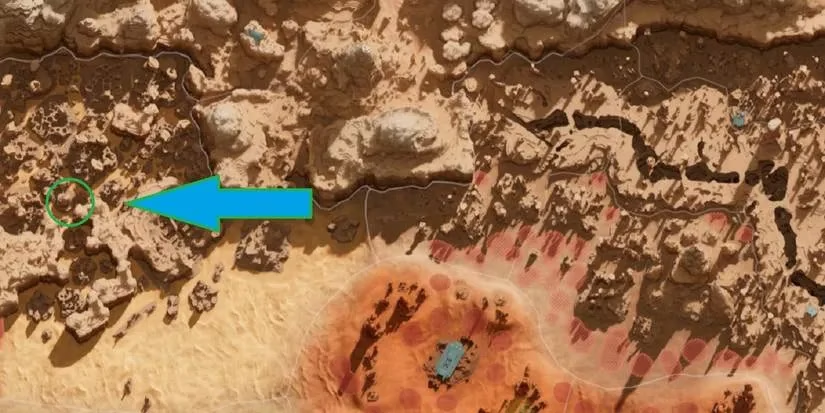
Reaching this foreboding place is the first trial. The vast, open basin is a killing field for the unprepared. The ever-present threat of a sandworm's maw makes traversing the dunes on foot an act of suicidal folly. A sandbike or ornithopter becomes not a luxury, but a vital organ for the journey, its hum a fragile shield against the planet's primal hunger. To approach the facility without one is to offer oneself to Shai-Hulud like a leaf on the wind, a momentary distraction before the great devourer returns to its depths.
Upon breaching the facility's outer shell, a different kind of claustrophobia sets in. The interior is a stark contrast to the open desert—a maze of sterile corridors and humming machinery, lit by the cold glow of suspensor lamps. Progress is not a matter of brute force, but of patient acquisition. The path is gated by shimmering energy shields, each requiring a specific identification bracelet to deactivate. These bracelets are scattered like breadcrumbs through the complex, forcing the hunter to explore every side chamber and bypassed laboratory. The facility itself becomes a silent adversary, a labyrinthine puzzle box that must be solved before one can even glimpse the prize within. The journey through its halls is a slow, deliberate dance, where each new bracelet collected feels like turning a tumbler in a complex lock.
Finally, after navigating this gauntlet of ancient technology, the heart of the facility is revealed. The chamber housing the Maas Kharet Assassin is no simple antechamber. It is here that the contract's true nature unveils itself. The assassin is not a solitary predator awaiting a duel; they are the centerpiece of a deadly tableau. The room is a hornet's nest of aggression, buzzing with a mixed garrison of loyalists. Standard troopers provide a chattering wall of fire, while elite guards, encased in personal shield bubbles that shimmer like soap films on oil, advance with methodical, deadly intent. The Maas Kharet Assassin moves among them, a specter of focused lethality.
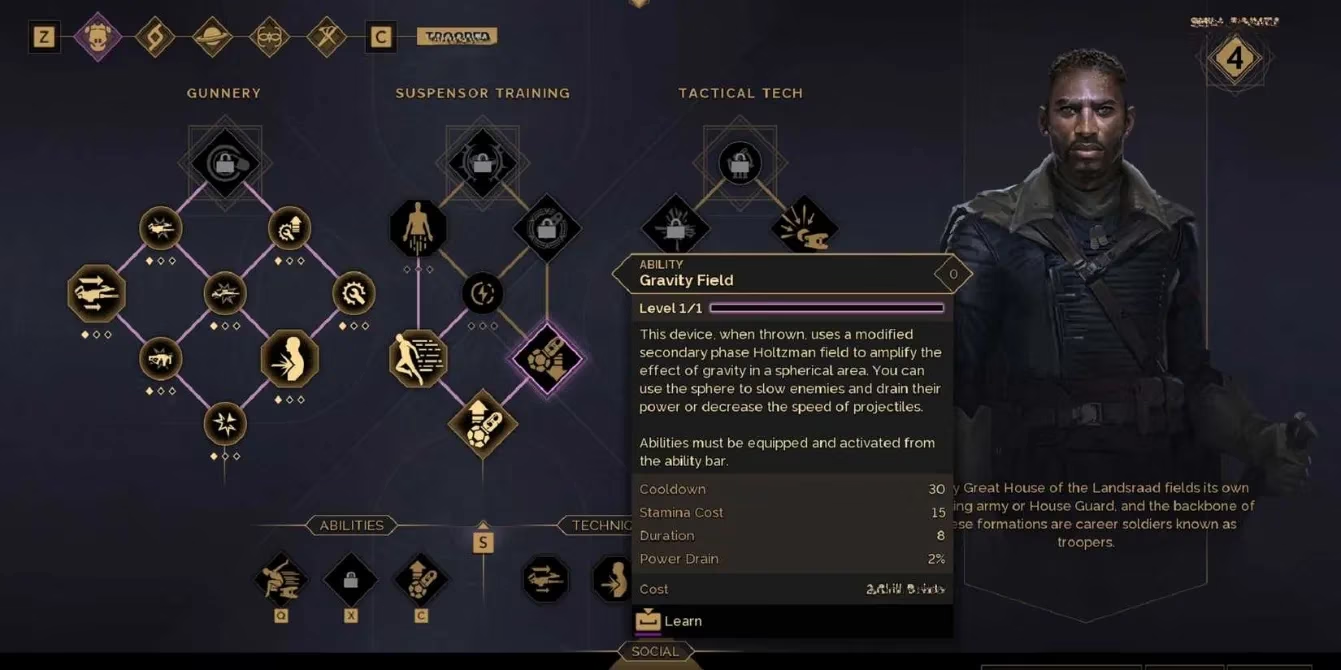
Confronting this force head-on, in the open center of the chamber, is a recipe for a quick and final martyrdom—one's own. Preparation is paramount. The modern freelancer has tools beyond the crysknife and lasgun. A well-placed grenade can disrupt formations, while the Trooper discipline's Gravity Field ability is a game-changer. Unleashing it is like casting a net of solidified time; enemies caught within are frozen, suspended in mid-action like insects in amber, creating precious seconds to thin their ranks. Without such specialized tools, tactical retreat becomes a weapon. Luring enemies into the narrow hallway leading to the chamber funnels them into a kill zone, turning the architecture of the facility against its defenders.
The aftermath of the clash is a scene of eerie quiet, broken only by the sputtering of damaged electronics. With the Assassin and their guard defeated, the contract's secondary objective—often unstated but universally understood—beckons. On the far side of the chamber, away from the entrance, a storage chest sits, its presence a quiet promise. Its contents—spice, rare components, or perhaps a schematic—are the desert's tribute to the victorious. To leave it unopened is to ignore a fundamental law of Arrakis: plunder what you can, for the desert takes everything in the end.
Only then, with the chest looted and the facility silent, is the contract truly ready for closure. The return journey, though no less dangerous, feels different. The freelancer must navigate back across the Hagga Basin to a place of civilization—be it the bustling trade post, the imposing sprawl of Arrakeen, or the hardy outpost of Harko Village. Finding the Contract Board, now a familiar sight, and marking the task complete is the final act. The reward, a infusion of Solari and hard-earned experience, is more than just currency. It is a testament to survival, a proof of capability in a world that offers neither pity nor second chances. The "Making a Martyr" contract chain, in the end, isn't just about creating a martyr; it's about ensuring you are not the one being memorialized.