
The Pulse Beneath the Sands: Respawn Rhythms in Dune: Awakening
Arrakis's survival hinges on loot respawn cycles: chests refresh individually after 45 minutes, while ore deposits globally respawn every 10.
Across the vast, rust-colored ocean of Arrakis, the desert does not forgive. The sun bleaches bone and metal alike, the wind scours flesh from memory, and the deep sand hides both death and revelation. In this world, every scrap of salvage, every glint of ore, every fuel cell is a stolen breath. To survive is not merely to scavenge—it is to dance with the planet’s own hidden heartbeat, to learn the cadence of a world that renews itself in silence. The traveler who fails to listen will wander forever, finding only the ghostly footprints of those who came before. To truly thrive, one must understand the twin tides of Arrakis: the eternal return of its treasures and its terrors.
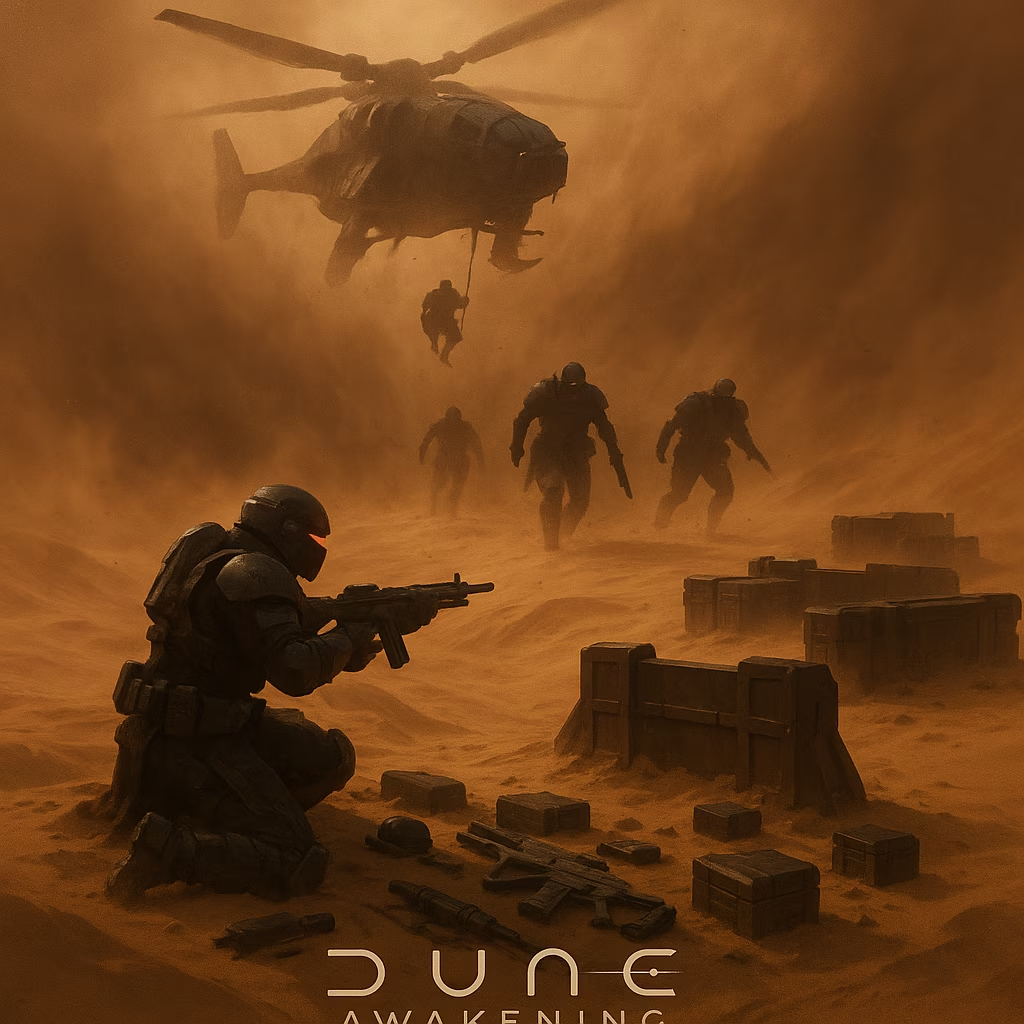
The land does not hoard its gifts. It offers them in cycles precise as a thumper’s echo. For those with patience, the desert blooms again. Chests—those dusty containers of hope, tucked into the ribs of crashed ships and forgotten corners of scavenger camps—obey a private rhythm. Once looted, they do not vanish for all. Instead, each chest remembers the hand that opened it. It enters a solitary slumber that lasts forty-five minutes by real‑time reckonings of the off‑world clocks. When the moment arrives, it awakens, its contents rearranged like a dream forgotten, and waits. Only for that one hand does it shine again. For another soul, who came later or earlier, the chest may still be ripe. No competition cuts its throat here. Every pilgrim walks his own trail of sealed promises.
Consider two wanderers beneath the pale sky. One opens a chest just after the second dawn, when shadows still lean long. The other, trailing by five minutes, finds the same lid unlooted, its bounty whole. The first sees his chest rebirth at the stroke of the forty‑fifth minute; the second must endure until her own private hourglass runs dry. Time, for these vessels, is a personal communion. They are islands of abundance in a shared sea of scarcity. The wise journeyer learns to mark these moments on the map, weaving invisible ribbons of return across the erg. There is no need to linger. The chest does not care if you stay. Proximity is meaningless; the desert’s machines turn regardless of your vigil.
Yet the world itself breathes a faster breath. Ore deposits that jut from rock like the bones of ancient sandworms—grindstone, copper, and rarer metals—they belong to everyone. The same wind that strips moisture from the flesh also strips the vein of its riches for all to see. When a miner’s cutter bites into the crumbling crust and scoops the last precious fragment, the land knows. A count begins, a ten‑minute whisper in real time. Until that moment passes, the deposit is a scar, visible but hollow. No second traveler, no friend standing patiently behind, can harvest from that same scar. It is one, and then none, until the pulse returns.
This same law binds the creatures of the deep desert and the camps they infest. A scavenger camp is a blister of human refuse, its inhabitants clutching rusty blades or ancient maula pistols. When a warrior cleanses the camp—breaking salvage, gathering spilled supplies, and silencing every last feral cry—the space becomes a quiet graveyard. Another who stumbles into it immediately after will find only sand‑scuffed footprints and silence. Ten minutes must pass. Ten minutes for the server’s invisible heart to beat once, and then life sprints back: enemies reform from the heat‑shimmer, salvage crates materialize, and the bloodstains blow away. But here, a deeper magic stirs. The new configuration is never quite the old. A camp that once held two men might now hold three, their weapons swapped. One with a cutting blade, another with a projectile thrower—or all of them armed with gunpowder and desperation. The desert reshuffles the deck each time it deals.
Observe the paradox: a player could purge a camp, then stand motionless in its center, counting the seconds. The corpses, the broken salvage, the sense of victory—all remain as testament. And then, at precisely the mark, everything rebuilds around her. Enemies coalesce from the air, chests become plump with new mystery, ore veins creak with renewed weight. Proximity is no shield; it is simply irrelevant. The renewal is cosmic, mechanical, indifferent to the trespasser’s patience. This is not a world that rewards guarding ruins. It rewards those who move, who course through the landscape like spice‑scented currents, touching each node only when its time aligns.
To master Arrakis is to build a map of time, not merely of space. The planner’s mind becomes a clockwork of intersecting circles. A route might begin at a copper‑rich ridge, known to reawaken at a certain hour, then sweep toward a shipwreck where Plasteel Microflora Fiber gleams with certainty inside its fixed chests. Certain treasures are absolutely reliable: the Microflora Fiber does not play dice. It lives only in those metallic tombs, always present, a constant star in a random sky. After that, the path curls toward a scavenger enclave, timed to arrive just as the ten‑minute silence shatters into hostile noise. Between these fixed points, the traveler harvests the wild cards—fuel cells that may or may not bloom beside a rock, ore that sometimes yields double, chests that offer unexpected blueprints. The art is in minimizing empty strides, maximizing the collisions between arrival and rebirth.
| Resource Type | Respawn Timer | Shared or Personal | Notes |
|---|---|---|---|
| 📦 Chests & Containers | 45 minutes (real time) | Personal per player | Contents are per‑player, no competition; random loot but some fixed special items |
| ⛏️ Ores, 💎 Overworld items, 🛠️ Salvage, 🧟 Enemies | 10 minutes (real time) | Shared across server | First‑come, first‑served; enemies and loot vary each respawn |
A deeper table still governs the philosophy of movement. Let it unfold:
| Aspect | Chests | World Resources & Enemies |
|---|---|---|
| Respawn Trigger | Starts upon looting, per player | Starts upon depletion/clear, globally |
| Competition | None—multiple players can loot the same chest independently | High—only one player or group benefits per cycle |
| Fixed Items | Plasteel Microflora Fiber always in shipwreck chests | None guaranteed, all random |
| Proximity Effect | None, respawn happens even if player stands next to it | None, same as chests |
| Best Strategy | Note personal timestamps; revisit when 45 minutes have elapsed | Coordinate with groups or claim timed routes to arrive first |
This dance is not without its poetry. The desert, in its coded mercy, never forces eternal deprivation. It simply demands rhythm. Ten minutes for the shared world, forty-five for personal vaults. These two timers beat like a heart and a lung, distinct yet coupled, sustaining the body of the game. Hot wind scours away frustration: even if a rival strips a vein before your eyes, the wait is short. Even if a chest seems empty, it was never truly empty for you—your key is always still to come. The system turns predators into pilgrims, teaching forbearance. In the deep desert, the man who waits in fury gains nothing; the woman who sails on to the next promised rise, knowing her own tide will roll back in forty‑five minutes, becomes a queen of the sand.
The wise player lays routes like prophecies. He leaves a camp not as a farewell, but as a promise to return. She sees the empty ore nodule not as loss, but as a counting star. Every ten minutes, the horizon resets. Every forty-five, a private feast awaits. This is the true meaning of the Dune: Awakening—not merely to survive, but to awaken to the cycles that hold the world together. Step from your stillsuit, look out at the shimmering waste, and know that beneath the arid silence, a clockwork hums. All you must do is move with its tick, and the desert becomes a garden in slow, faithful bloom. ⏳🌵🗺️